Until the late sixties very little was known about how the brain coordinates
eye movements. Consequently, the models proposed to describe the "processing"
that the brain does were based on the so-called "black-box" approaches
-- having little scientific value. However since 1968, when the first
single-cell neural recording took place, a great deal of information has
been accumulated regarding the anatomy and the physiology behind eye movements.
The work in this lab is aimed at developing better models to describe
the workings of the brain in controlling eye movements and their coordination
with head movements based on what we have learned from mother nature.
THE VESTIBULO-OCULAR REFLEX (VOR)
Our body relies on a variety of reflexes in order to thrive in a dynamic
world. You may have experienced the muscle stretch reflex that a doctor
tests by tapping your knee during a routine medical exam. Our eyes are
also subject to reflexive mechanisms that are usually taken for granted.
One such reflex is the vestibulo-ocular reflex or VOR as it is called.
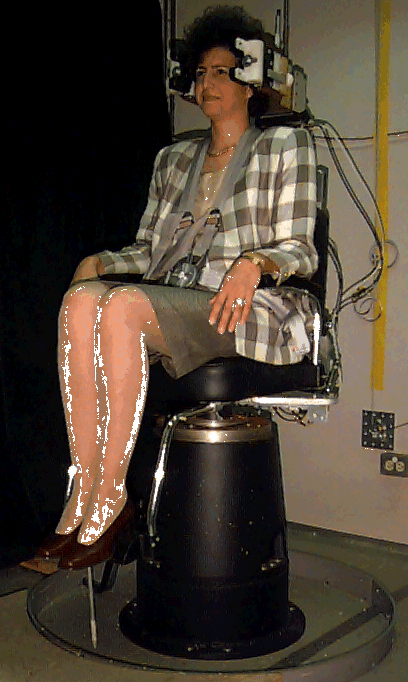 The goal of our vision system is to keep the image of the world stable
on the retinas so that we do not feel nauseous as we go about our daily
business. The VOR uses sensory information from semi-circular canals,
located in the inner ear, to compensate for head motion. (These canals
are also responsible for our sense of balance.) The VOR, for instance,
allows you to walk along a street and keep a clear view of the world as
your head bounces up and down.
The goal of our vision system is to keep the image of the world stable
on the retinas so that we do not feel nauseous as we go about our daily
business. The VOR uses sensory information from semi-circular canals,
located in the inner ear, to compensate for head motion. (These canals
are also responsible for our sense of balance.) The VOR, for instance,
allows you to walk along a street and keep a clear view of the world as
your head bounces up and down.
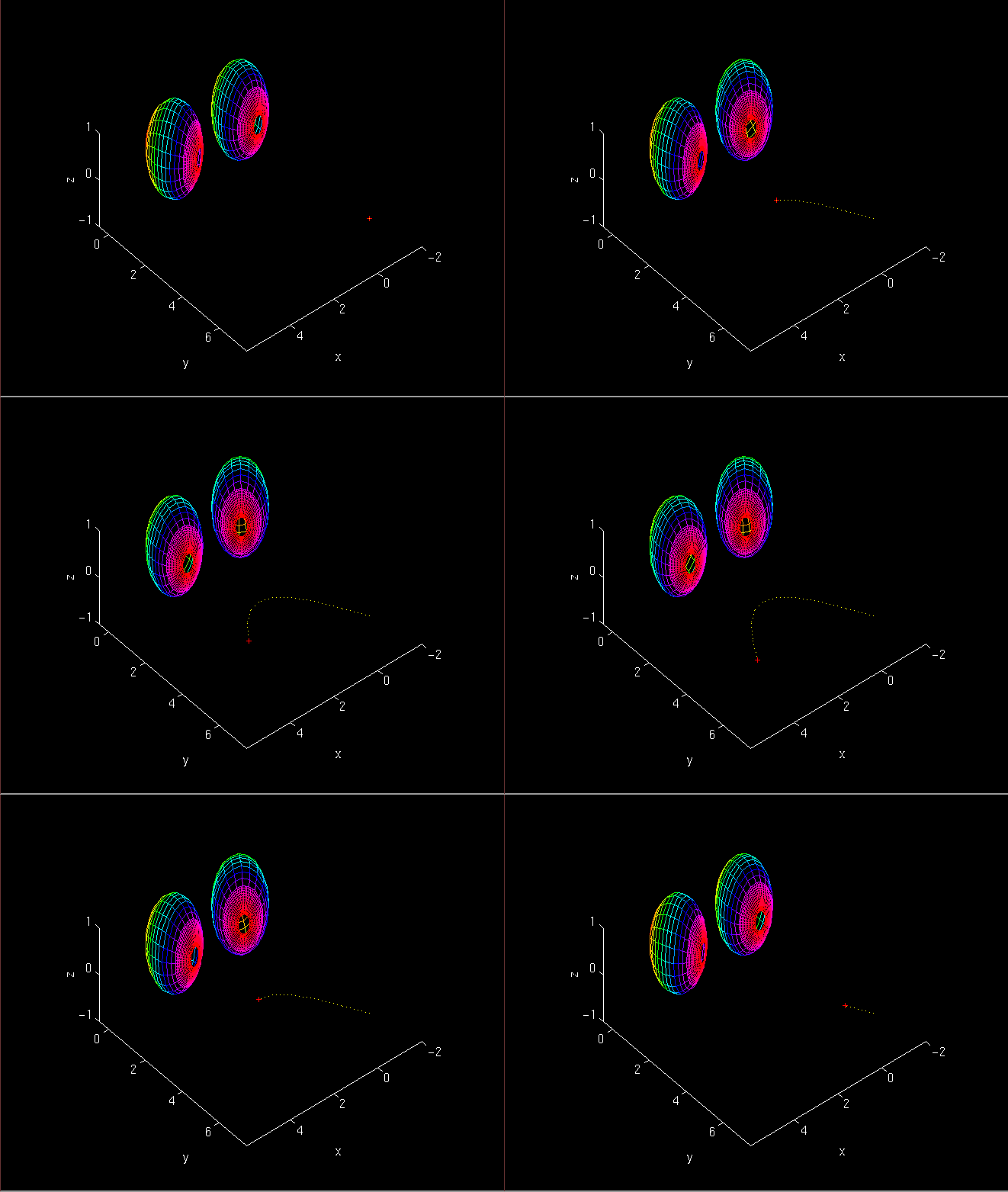
In the lab, we have developed a model of the VOR which relies on the experimental
observations recorded by neurophysiologists. Our model is the first in
the world which conscientiously tries to mimic the functionality of the
brain.
TRY YOUR VOR
Hold a piece of literature in your hands and shake the document left-to-right
until it is difficult to read. Now hold the document steady and shake
your head in the same way. You should now notice that it is easier to
read the writing because your VOR is causing your eyes to rotate in the
opposite direction to your head.
ROBOTIC VISION SYSTEM
 People who build robots having artificial vision are faced with the same
design problems that mother nature had when she designed vertebrate lifeforms.
At the very least, a vision system needs to be able to execute slow and
rapid eye movements and be able to compensate for camera shake. To date,
all of the robotic vision systems have been built using black-box approaches
and have yielded poor performance. One branch of research in this lab
is to apply biological eye-control strategies to the field of artificial
vision.
People who build robots having artificial vision are faced with the same
design problems that mother nature had when she designed vertebrate lifeforms.
At the very least, a vision system needs to be able to execute slow and
rapid eye movements and be able to compensate for camera shake. To date,
all of the robotic vision systems have been built using black-box approaches
and have yielded poor performance. One branch of research in this lab
is to apply biological eye-control strategies to the field of artificial
vision.
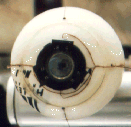
Presently, the lab has a rudimentary pair of artificial eyes that are
used to evaluate the performance of a biological-based control scheme.
These eyes are controlled using a computer. The next stage is to place
the eyes in a movable head.
BETTER VIRTUAL REALITY
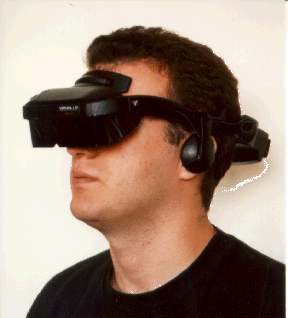 One of the complaints of people who wear virtual reality (VR) goggles
is that they feel nauseous soon after putting them on. Our newest project
in the lab is to improve the goggles so that a user does not feel sick
when immersed in a virtual world.
One of the complaints of people who wear virtual reality (VR) goggles
is that they feel nauseous soon after putting them on. Our newest project
in the lab is to improve the goggles so that a user does not feel sick
when immersed in a virtual world.
ZsB-M
Last modified: Fri Sep 20 00:20:48 1996